| Metric | Austin · 1 m LiDAR | Kathmandu · 30 m DSM |
|---|---|---|
| Elevation source | USGS 3DEP LiDAR | Copernicus GLO-30 |
| OSM footprints fetched | 1,795 | 7,290 |
| Buildings analyzed | 1,728 | 947 |
| Footprint survival | 96.3% | 13.0% |
| Mean roof slope | 40.3° | 3.7° |
| Usable roof fraction | 0.47 | 1.00 |
| Median kWh / building | 7,404 | 14,355 |
| Total annual kWh | 19,187,570 | 36,256,333 |
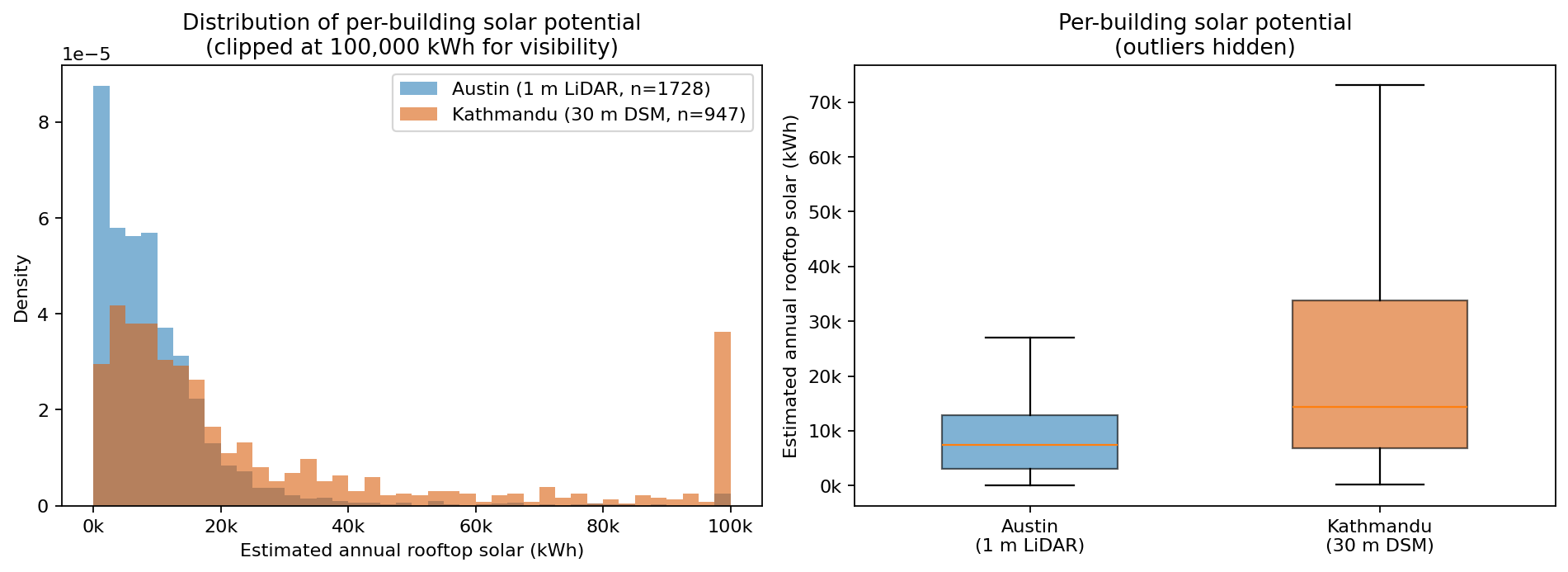
The two cities' per-building distributions are statistically distinct. A Mann–Whitney U test rejects equal distributions (p ≈ 10⁻⁶⁸) and a Kolmogorov–Smirnov test confirms a large separation (D = 0.31).
Kathmandu's median per-building estimate (14,355 kWh) is nearly double Austin's (7,404 kWh), even though Kathmandu's buildings are physically smaller. Section 03 traces this gap to the input data rather than to any real difference between the cities.
Two compounding mechanisms produce the directional bias:
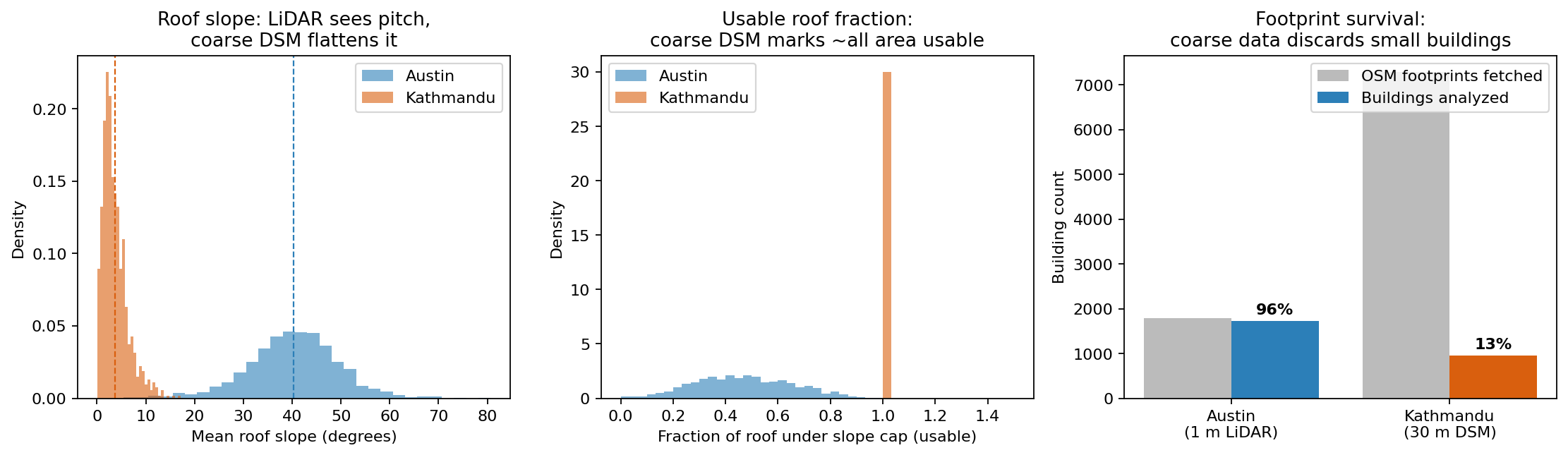
- Roof-pitch flattening. At 1 m, LiDAR resolves individual roof planes (mean slope 40.3°, only 47% of area usable). At 30 m, one cell spans an entire small building, averaging pitched surfaces into a near-flat patch (slope 3.7°, 100% usable). The coarse DSM cannot see that roofs are tilted, so it over-credits usable area.
- Small-building dropout. A 30 m cell is larger than many Kathmandu buildings; footprints with too few valid cells are dropped. Only 13% of fetched footprints survive, biasing the sample toward large, high-yield structures.
Building footprint area correlates strongly with estimated yield (Pearson r = 0.98 Austin, 0.92 Kathmandu), confirming usable area as the dominant driver; usable area is also the quantity the coarse DSM distorts.
Airborne LiDAR (Austin)
- Resolves roof planes: per-facet slope, aspect, and usable area.
- High footprint survival; nearly all buildings analyzable.
- Not openly available for most of the world; large files, heavier to process.
Open global DSM (Kathmandu)
- Globally available, free, and fast; the only option where LiDAR is absent.
- Adequate for coarse screening of districts and large rooftops.
- Cannot resolve roof planes; flattens pitch, over-credits usable area, drops small buildings.
- Per-building values are reliable only as a relative screen.
- Irradiation values are placeholders (Austin 1,700; Kathmandu 1,800 kWh/m²/yr); absolute totals are provisional, while relative within-city rankings are robust.
- Kathmandu is a footprint-level screen at 30 m; roof-facet design would require finer data.
- First-order energy model; no inter-building shading in the Python step.
- OSM footprint completeness and the choice of footprint dataset materially affect Kathmandu totals.
See how the LiDAR was processed
The full point-cloud-to-surface methodology, and the reproducible code.