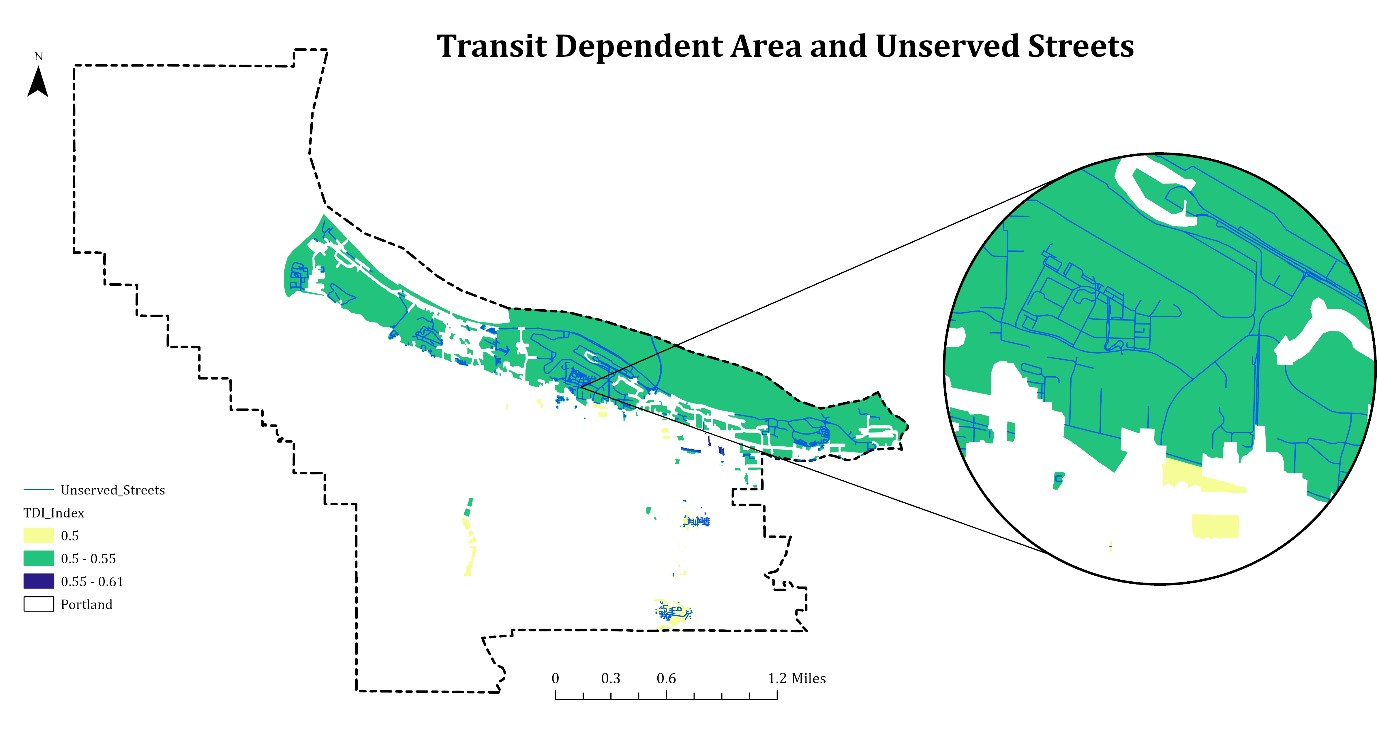
Portland has a strong transit system overall, yet service is not evenly distributed. Some neighborhoods with the highest dependence on public transit still fall outside the walking-distance service area of any bus stop.
The tool quantifies that mismatch and outputs the specific street segments where the gap is worst, so planners can target investment.
It is built as a reusable, parameterized geoprocessing tool, so the same workflow can be re-run for any city.
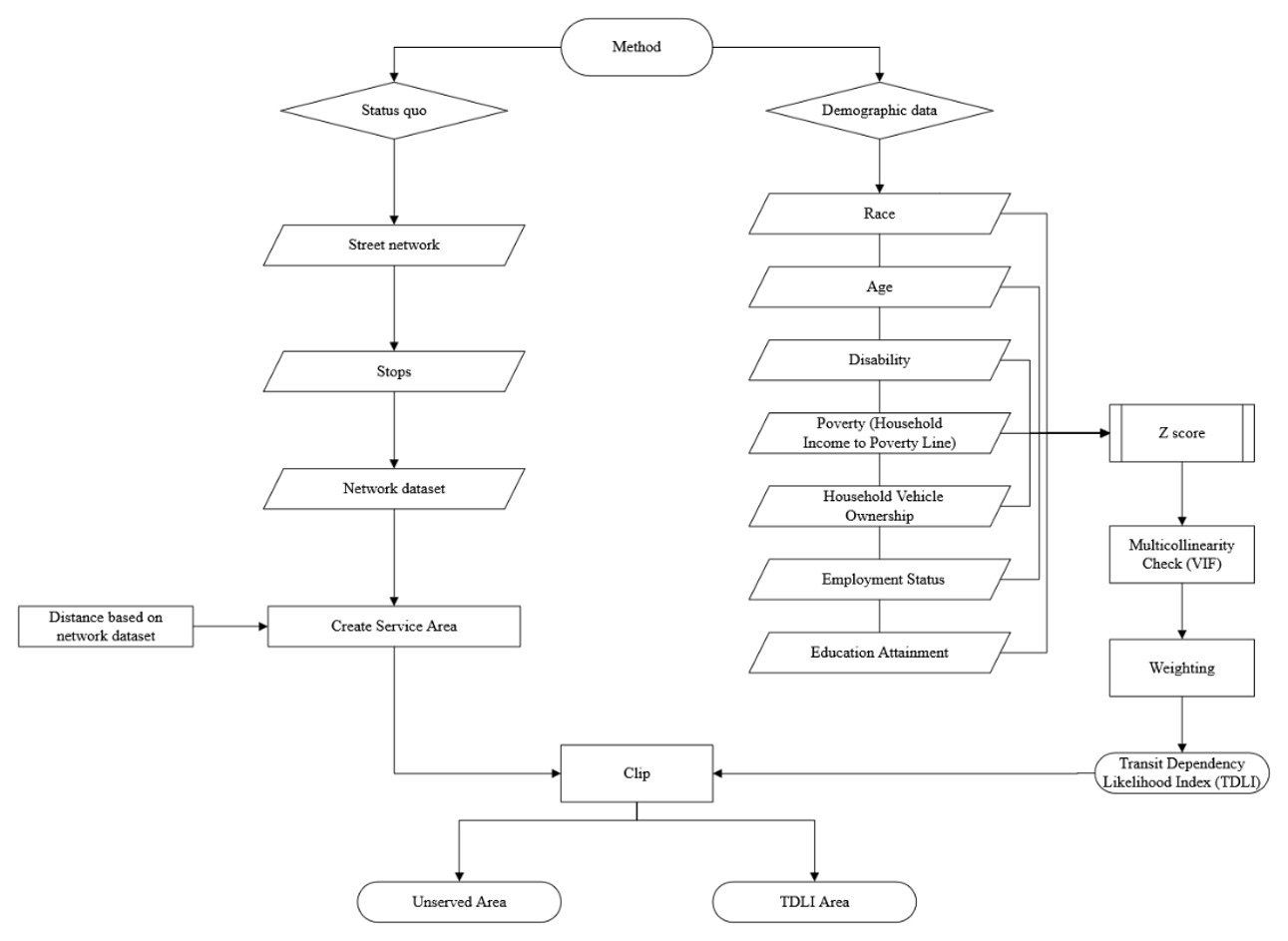
- Read a polygon layer and user-selected demographic fields with ArcPy.
- Standardize each variable with z-scores, reclassify into weighted scores.
- Compute a weighted Transit Dependency Index per polygon.
- Run a multicollinearity (VIF) check on the variables.
- Build Network Analyst service areas around bus stops at a walking-distance threshold.
- Use symmetric difference + clip to isolate high-need areas outside coverage and output the unserved streets.
PORTLAND RUN · SETTINGS
| Parameter | Value |
|---|---|
| Variables | age 65+, poverty, minority, disability, vehicle access, education |
| Weighting | Equal |
| Service distance | 800 ft around active stops |
| High-need threshold | TDI ≥ 0.5 |
High transit-dependency areas concentrate in the northern part of the city, and many fall outside the 800-ft service area of existing stops, a clear mappable service gap. The demographic profile of those zones lines up with the vulnerability the index is meant to capture.
The output unserved-street layer gives planners a direct, actionable target for new stops, routing changes, or micro-transit.
- Single accessibility radius for all transit modes (next: mode-specific radii).
- Ignores service frequency and reliability (next: schedule-based weighting).
- Add data-quality and CRS checks; package as a
.pytPython toolbox.
Read the code
Full ArcPy tool, toolbox, README, and maps on GitHub.